
Malawi: The Current Landscape and Systemic Challenges of Orthopaedic Care
Editorial | Published : 25-Jun-2026 | Open access
Abstract
Malawi faces a substantial and growing burden of musculoskeletal injury, largely driven by road traffic trauma, and limited access to timely surgical care. The delivery of orthopaedic services is shaped by a highly centralised health system, with non-operative care provided predominantly at district level by orthopaedic clinical officers and operative services concentrated in a small number of tertiary hospitals. This editorial examines the current landscape of orthopaedic care in Malawi within its broader socioeconomic and health system context.
Despite the essential role of task-shifting models and recent advances in training, major challenges persist, including severe workforce shortages, infrastructure limitations, inconsistent access to essential equipment, and delayed presentation due to geographic and financial barriers. The economic consequences of injury are substantial, with prolonged disability contributing to income loss and reinforcing cycles of poverty. Strengthening orthopaedic care in Malawi will require sustained investment in surgical capacity, decentralisation of services, workforce retention, and integration of musculoskeletal health into national health planning. Addressing these priorities is essential to improving equitable access to care and supporting the country’s long-term development goals.
Introduction
Malawi is a small, landlocked country in southeastern Africa with an estimated population exceeding 20 million, approximately 84% of whom reside in rural areas [1]. Nearly one-fifth of the country’s surface area is occupied by Lake Malawi, the third-largest lake in Africa [2]. Despite its natural resources, Malawi remains among the world’s least developed nations, with an economy heavily dependent on agriculture and a gross domestic product (GDP) per capita of approximately USD 508 in 2024, substantially lower than that of neighbouring countries such as Zambia and Tanzania [3]. More than 70% of the population lives below the international poverty threshold of USD 3.00 per day [4].
Malawi faces a substantial burden of injuries, with a road traffic fatality rate estimated at 33 per 100,000 population, nearly double the global average [4]. The majority of these injuries are musculoskeletal in nature and require orthopaedic intervention [5]. Understanding the challenges of orthopaedic care delivery in Malawi therefore requires consideration of both the health system structure and the broader socioeconomic context in which it operates.
The Malawi Health System and Service Structure
Healthcare delivery in Malawi is organised into three tiers:
Primary care: Delivered through health centres, serving as the first point of contact, particularly in rural areas.
Secondary care: Provided at district hospitals, which manage referrals and conditions beyond the capacity of primary facilities.
Tertiary care: Delivered at central hospitals located in major cities, offering specialised services.
Most health facilities are publicly owned and operated by the Ministry of Health. The Christian Health Association of Malawi (CHAM) complements public services through a faith-based network, particularly in remote regions. Additional providers include non-governmental organisations and a small private sector. Access to private healthcare remains limited, with fewer than 1% of Malawians covered by medical insurance [7, 8]. A small number of private hospitals provide care comparable to high-income settings, but these services are accessible only to a privileged minority.
Orthopaedic Care Delivery: A Centralised System
The organisation of orthopaedic services reflects the broader health system structure. Primary health centres lack radiological facilities and are unable to diagnose or manage fractures, making district hospitals the first point of effective orthopaedic contact.
At district level, care is primarily delivered by Orthopaedic Clinical Officers (OCOs), a non-physician cadre unique to Malawi and a small number of other low-income countries. OCOs typically complete a three-year clinical medicine programme followed by 18 months of orthopaedic training. Their practice focuses on non-operative fracture management using traction, casting, and splinting, as well as emergency care for open fractures. Malawi currently employs approximately 135 OCOs, whose contribution is critical in rural and semi-urban districts [9, 10].
All operative orthopaedic care is provided at four tertiary hospitals located in Blantyre, Lilongwe, Zomba, and Mzuzu, where the country’s 19 orthopaedic surgeons are based. This centralisation contributes to significant inequities in access, particularly for rural populations.
Challenges in Orthopaedic Care
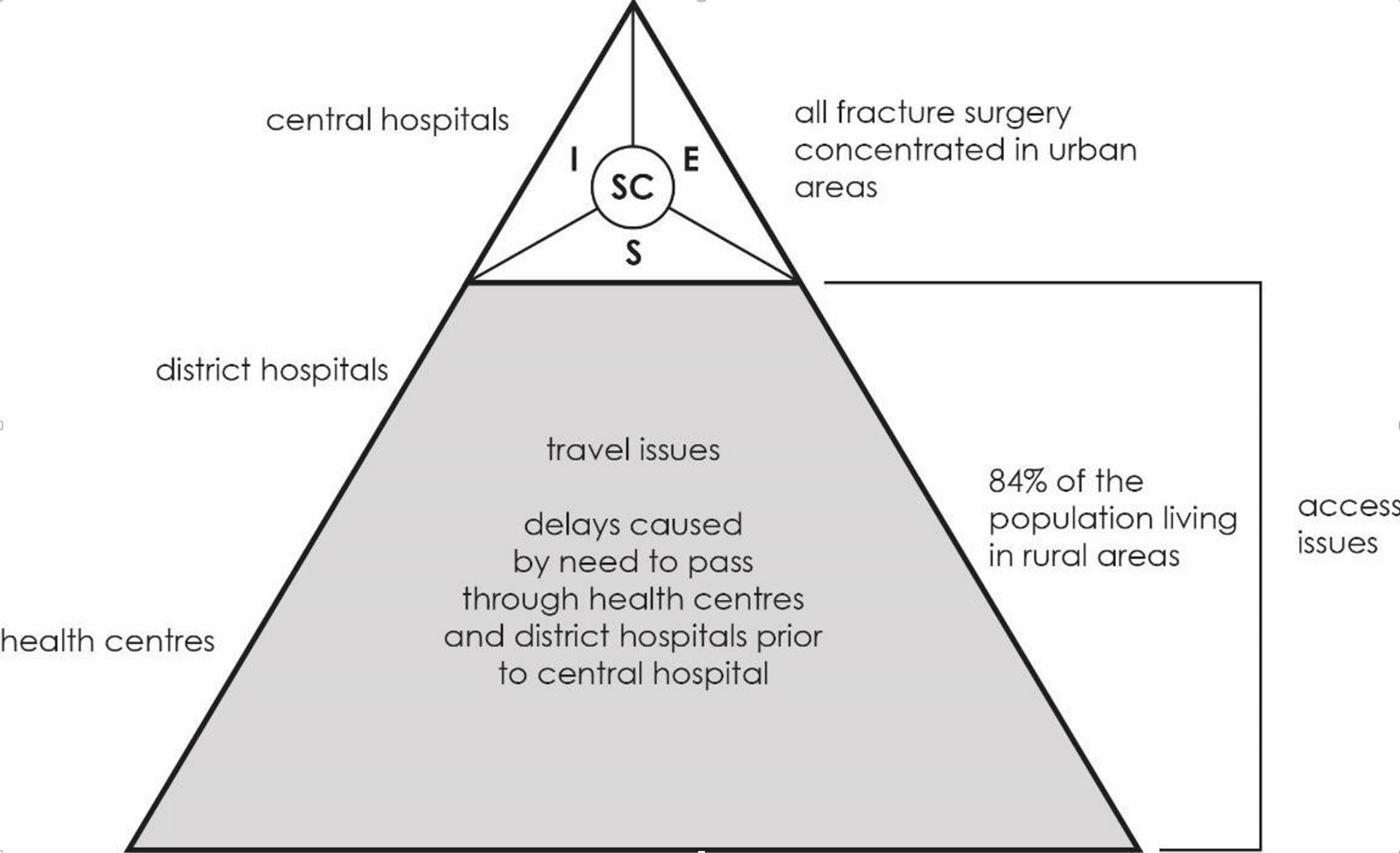
The barriers to effective orthopaedic care in Malawi can broadly be classified into two domains: limited surgical capacity and delayed access to care.
Surgical Capacity
Surgical capacity depends on infrastructure, equipment, and skilled personnel, all of which are constrained in Malawi.
Human resource constraints. With only 19 orthopaedic surgeons serving more than 20 million people, Malawi has one of the lowest surgeon-to-population ratios in sub-Saharan Africa [11]. All surgeons are based in tertiary hospitals, leaving district hospitals dependent on Orthopaedic Clinical Officers for non-operative care. Shortages of anaesthesia providers, nurses, and physiotherapists further limit comprehensive service delivery.
Infrastructure deficits. Operating theatres at district hospitals are shared with high-demand services such as obstetrics and general surgery, leading to competition for theatre time and delays in orthopaedic procedures. Tertiary hospitals also experience overcrowding, with trauma cases frequently displacing elective surgery.
Equipment and supply shortages. Essential supplies such as plaster of Paris, traction equipment, implants, and sterilisation tools are frequently unavailable. Although many district hospitals possess X-ray machines, maintenance issues and frequent breakdowns reduce functionality. Advanced imaging modalities, including CT and MRI, are restricted to a small number of tertiary centres and are not consistently operational [12]. The absence of fluoroscopy in most hospitals further limits safe surgical fixation.
Delayed Access to Care
Geographical and socioeconomic barriers compound inequities in access. With most of the population living in rural areas, patients often traverse multiple referral levels before reaching facilities capable of definitive care. Poor road infrastructure, limited ambulance services, and transport costs contribute to delayed presentation. As a result, neglected fractures, malunions, non-unions, chronic infections, and advanced disease are common presentations at tertiary centres.
Economic Burden
Although public healthcare is officially free, patients incur substantial out-of-pocket expenses for transport, food, and essential medical supplies. These costs can be catastrophic [13, 14], particularly in a country where over 90% of the workforce is employed in the informal sector without social protection [15]. Non-operative fracture management, although less cost-effective and associated with poorer functional outcomes than surgical fixation, remains common due to resource limitations [16–18]. Prolonged immobilisation and disability contribute to income loss, reinforcing cycles of poverty and inequality [19–22].
Implications for National Development
The consequences of inadequate orthopaedic care extend beyond individual morbidity. Musculoskeletal injuries disproportionately affect the working-age population, reducing productivity and increasing dependency. Without investment in surgical systems, Malawi risks undermining the goals of Malawi Vision 2063, which identifies human capital development and a healthy, productive population as central to sustainable growth [23].
Conclusion and Way Forward
Orthopaedic care in Malawi faces a complex interplay of systemic, geographic, and economic challenges. The system remains heavily centralised, with operative services concentrated in urban tertiary hospitals, leaving the rural majority underserved. Non-operative management continues to dominate despite clear evidence of its limitations.
To move forward, Malawi must make orthopaedic care more equitable. Partnerships between government, academia, and international institutions have begun to yield progress, but sustained investment is essential to retain specialists and ensure equitable service distribution. Strengthening the health system across all three tiers will facilitate decentralisation, improve access and allow tertiary hospitals to focus on complex cases. Integrating orthopaedic services into broader initiatives such as the National Surgical, Obstetric and Anaesthesia Plan (NSOAP) will ensure musculoskeletal health receives the attention it deserves. Such reforms will make access to safe, timely, and affordable orthopaedic care a reality for all Malawians, advancing the Malawi 2063 Vision for human capital development and UN Sustainable Development Goal 3 on good health and well-being.
About this article
Received
Saturday, August 22, 2026
Published
Saturday, August 22, 2026
DOI
https://doi.org/10.63842/tos.2026.article30